Navtika

November 28, 2025

Blog

Teaching KIDS SUSTAINABILITY & Global Responsibility Through TECHNOLOGY

 Year 2025 | Vol XVI | Issue No. 1 (August – November 2025) Author: Sonal Jha Abstract Technology is no longer a tool; it has become a teacher. Nowadays, before holding even a pencil, kids are holding phones. This article explores how digital resources such as games, apps, and storytelling platforms can be leveraged to teach complex concepts like sustainability and global responsibility. By integrating interactive digital tools, educational apps, and age-appropriate multimedia content into early childhood classrooms, educators can foster environmental awareness and social empathy in engaging, relatable ways. The article highlights strategies and examples that demonstrate how technological resources can nurture eco-conscious habits, promote global citizenship, and inspire children to become thoughtful stewards of the planet from an early age. It also includes case studies, surveys, and research-based insights to show how the right tech and intent can make value-based education engaging, relevant, and future-ready. Introduction In today’s interconnected world, it is vital to instill the principles of sustainability and global responsibility in children from an early age. With technology becoming an integral part of their lives, it offers a powerful medium to engage young minds in understanding and caring for the world around them. Through thoughtfully designed digital tools and interactive experiences, educators can introduce concepts like environmental care, cultural diversity, and responsible consumption in ways that are both meaningful and age-appropriate. This article delves into how technology can be a bridge to building a more conscious and compassionate next generation. Teaching Kids Sustainability & Global Responsibility Through Technology From mobile phones to screens, gadgets are omnipresent today. It is fair to say that children are growing up with gadgets. Thus, it is essential to make them understand the concept of sustainability and global responsibility. As per a report published by Happinetz, 42% of children under 12 years spend two to four hours daily on a screen. 47% of children, those above 12 years, are glued to the screen. But the question here is: How can technology be a helping hand in this matter? Will it help or add more screen time? Let’s explore how kids can be taught about essential issues using digital tools. The Urgency of Early Education in Sustain- ability Climate change is no longer a future threat; it’s already here. Global temperatures are at an all-time high, the weather is increasingly unpredictable, and natural disasters, such as droughts and floods, are in the news almost daily. As per the report of the Inter-governmentalPanel on Climate Change (IPCC) 2023, if global warming increases above 1.5%, the Earth will face irreversible damage in the coming decades. And who will it affect the most? The upcoming generation, the kids of today.So, it’s important to make them understand all these serious issues. But the problem is that we don’t teach them from childhood. Yes, environmental studies as a subject is there, but it’s limited to definitions and facts. Slogans like “say no to plastic” and “save water ” are raised, but awareness may still be lacking due to limited explanation of “how” and “why?” That’s why it is essential to have sustainability in education and global citizenship. These are not just textbook skills but shape the lifetime behaviour of kids as citizens. When values like empathy, responsibility, civic sense, and long- term thinking are embedded from a young age, it not only helps children be aware but also action-oriented.Developing a world view, this is not limited only to the environment. Global responsibility means seeing the world as an interconnected system. When a kid knows that their plastic bottle can pollute some other country’s river, or a tree planted by them gives oxygen, their thinking becomes global from local.This mindset shift is important. But how to teach this to children? Kids these days get easily bored with traditional classroom methods. So, the best way of teaching them is to utilize digital tools and screens smartly. Digital Behaviour in Early Childhood Today’s kids recognize YouTube’s logo before they say the word “Mumma”, and it’s not an exaggeration. According to a study by the National Institute of Health (NIH), the screen time of children by the age of 3 years is more than 2.5 hours daily. And these numbers have almost doubled post-pandemic. The trend is similar in India, too. However, screen time is not just a number. It reflects the learning style of kids, their attention span, and content exposure.  What Kids Watch?As per Kantar KidScan India Report 2024 – 61% of kids watch cartoons, nursery rhymes, and unboxing videos on YouTube and YouTube Kids. 34% watch mobile games like Minecraft and Roblox. Only 5% to 7% of kids use learning apps actively. What’s the Problem with this?Children watching screens is not the problem, but what they are learning from the screen is. Passive watching hurts their cognitive and emotional development, especially when the content is shallow. When they watch unboxing videos, a dopamine loop is triggered that suppresses real-world curiosity. The FlipsideWhen screen time is combined with the right content, it can be a superpower for children. A study by the American Academy of Pediatrics (2022) reveals that gamified content and interactive storytelling help children retain things they learn and develop values like empathy, cooperation, and problem-solving. So, the real challenge is not controlling screen time but optimizing screen quality. Kids’ behaviour shows that they think of the screen as a learning medium. Now, it is our responsibility to ensure they don’t see the screen only as a medium of entertainment but as a tool for sustainable and valued education. Role of Technology in Education Today Nowadays, a classroom feels incomplete without a smartboard. Textbooks are now Portable Document Formats (PDFs), homework is assigned on Google Classroom, and parent-teacher meetings are conducted on Zoom. In short, education is tech-enabled. However, the question arises: Is technology only for formality or for genuinely enhancing learning?EdTech boomed in India during the lockdown. As per Statista, the EdTech market was more than ₹34,000 crore from 2020 to 2023. But the problem
Blog

Integrated EDUCATIONAL Approaches

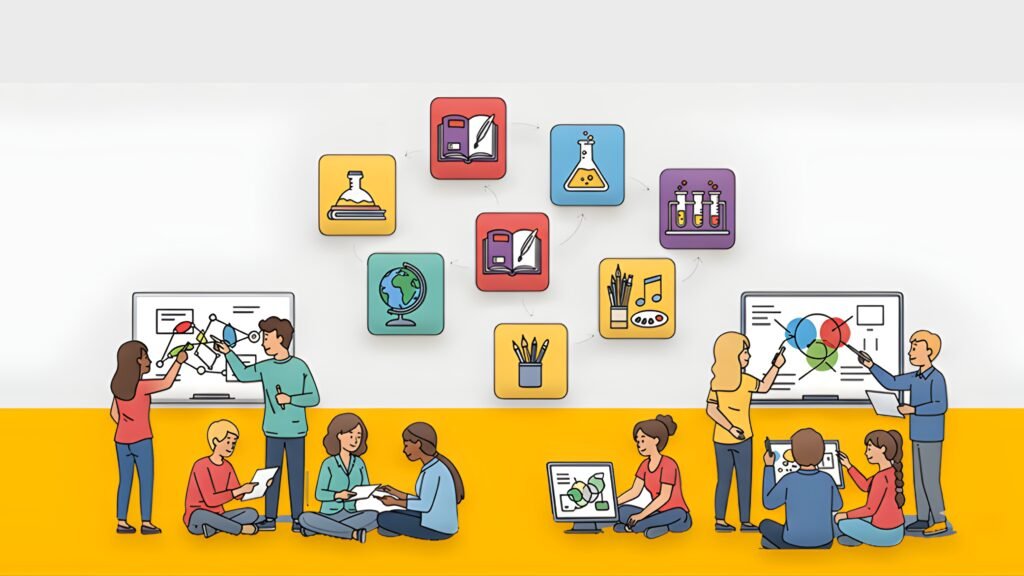
 Year 2025 | Vol XVI | Issue No. 1 (August – November 2025) Author: Archana Srivastava Abstract Integrated education combines multiple subjects, methods, and perspectives to create a holistic learning environment. This approach enhances critical thinking, problem-solving, and collaboration skills, connecting students to the real world. Introduction Integrated educational approaches mean combining multiple subjects, methods, and perspectives. As in 21st Century skills, we talk about the HOLISTIC DEVELOPMENT of students. Integrated education aims to create a Holistic & Effective learning environment for students. One of the words which we use for such integration is PHYGITAL, which is a fusion of physical and digital classroom. The objective of Integrated education is: A few examples of Integrated teaching are: Conclusion To conclude, integrated educational approaches have revolutionized the way we teach and learn science. By combining multiple subjects, methods, and perspectives, we create a holistic and effective learning environment that enhances critical thinking, problem-solving, and collaboration skills. The fusion of physical and digital classrooms (Phygital) has made learning more meaningful, interesting, and engaging. REFERENCES ABOUT THE AUTHOR Archana Shrivastava, is a distinguished educator with expertise in academic curriculum development and a Master’s degree in Zoology, she is a key faculty member at Sunbeam School in Varanasi Uttar Pradesh.

Blog

From Lessons to Practice: INTEGRAT INGSUSTAINABILITY in Early Years Learning

 Year 2025 | Vol XVI | Issue No. 1 (August – November 2025) Author: Rashi Oberoi Abstract Sustainable Development Goals (SDGs) are often relegated to curriculum checklists, treated as isolated topics rather than transformative frameworks. This article argues that sustainability must become an integral, lived experience in early education, woven into daily learning, language, and practice from ages 3 to 6 years. By immersing young children in sustainability through real-life experiences, systematic simulations, and creative innovation, the article progresses to show how we can foster lifelong habits and mindsets that transcend the classroom. The article outlines strategic sustainability goals for early years, proposes practical approaches for embedding them, and recommends digital tools and apps to empower educators and facilitators in making sustainability a living, breathing reality for young learners. INTRODUCTION The urgency of sustainable development is undeniable. Yet, in many educational settings, sustainability is reduced to a series of lessons, activities, or annual projects far removed from the daily realities and lived experiences of students. This approach risks creating a disconnect – students learn about sustainability but rarely live it. To truly prepare the next generation for the challenges ahead, sustainability must be more than a curriculum goal. It must become the fabric of early childhood education, shaping the way children think, speak, and act from their earliest years. Why Sustainability Must Be More Than a Curriculum Goal The Pitfalls of a Curriculum-Only Approach Strategic Sustainability Goals for Early Years (Ages 3–6) Below are suggested sustainability goals tailored for early childhood, designed to be woven into daily learning and play: Goal Description Example Activities Resource Awareness Understanding the value of water, energy, and materials Watering plants, turning off lights, recycling games Waste Reduction Recognizing waste and practicing reuse/recycling Sorting recyclables, upcycling crafts Nature Connection Building empathy for living things Gardening, nature walks, observing insects Healthy Living Choosing sustainable foods, hygiene, and movement Preparing healthy snacks, composting, exercise routines Community & Sharing Learning about fairness, sharing, and helping others Group projects, sharing circles, collaborative art Problem Solving Innovating solutions to everyday challenges Building with recycled materials, “fix-it” workshops Sustainable Language Using words and stories that reflect sustainable values Storytelling, sustainability-themed books, and role-play Embedding Sustainability: Practical Approaches for Ages 3-6 years Weaving Sustainability into Daily Routines: Morning Circles Begin each day with a “sustainability moment” – a question, story, or challenge related to the environment.Examples: Classroom JobsAssign roles like “energy saver,” “recycling leader,” or “water monitor.”Examples: Snack TimeDiscuss where food comes from, compost scraps, and encourage reusable containers.Examples: Real-Life Experiences and Simulations Mini-Ecosystems Create animal herds, classroom gardens or worm farms to observe cycles of growth and decay.Examples: Role-PlaySimulate real-world scenarios (e.g., a market, recycling center, or farm) to solve problems collaboratively.Examples: Field TripsVisit local parks, farms, or recycling centers to see sustainability in action.Examples: Experimentation and Innovation Tinkering Spaces Provide materials for children to invent new uses for “waste” items.Examples: Challenge DaysPose open-ended problems – “How can we save more water?” – and encourage creative solutions.Examples: DocumentationUse photos, drawings, and journals to track progress and reflect on learning.Examples: Introduce vocabulary: “renewable,” “reuse,” “compost,” “community.”Examples: Drawing and Visualizing Ideas- Invite children to draw solutions to environmental problems.Examples: Tools and Apps to Accentuate Curriculum Delivery The digital landscape offers a wealth of resources to support sustainability education for young children. Here are some standout tools and apps for facilitators: Tool/App Purpose Features EcoKids Interactive games on environmental themes Quizzes, activities, printable resources Gro Memo Teaches recycling and environmental care Animated games, child-friendly interface Green Screen by Do Ink Create sustainability-themed videos Easy video editing, creative storytelling Earth Cubs Global citizenship and sustainability Animated stories, games, teacher resources Toca Nature Explore ecosystems and biodiversity Virtual nature play, creative exploration Class Dojo Track sustainable behaviors and habits Digital portfolios, parent communication Recycle Hero Teaches recycling through play projects Sorting games, real-life scenarios Seesaw Document and share sustainability Multimedia portfolios, family engagement Ideas for Facilitators Digital Portfolios:  Ensuring Equity Conclusion Sustainability cannot remain a mere curriculum goal. It must become an integral, lived experience, especially in the formative years of schooling. By embedding sustainability into language, routines, and real-life experiences, and leveraging innovative tools and apps, educators can cultivate a generation of creative, empowered, and environmentally conscious citizens. The journey begins not with isolated lessons, but with a holistic, immersive approach that makes sustainability second nature for every child. REFERENCES ABOUT THE AUTHOR Rashi Oberoi rashoberoi@gmail.com Rashi Oberoi is an educator and administrator with experience in curriculum development. She has worked closely with agencies such as United Nations India Collaboration (UNIC), Lung Care Foundation at Sir Ganga Ram Hospital and Central Board of School Examination (CBSE) on environment campaigns.

Blog

NURTURING GLOBAL Citizens Through Play and Storytelling in EARLY CHILDHOOD

 Year 2025 | Vol XVI | Issue No. 1 (August – November 2025) Author: Sheuli Ghosh Abstract In the earliest years of life lies the greatest opportunity to shape a better world. This article explores how early childhood education can nurture global citizenship by embedding Sustainable Development Goals (SDGs)through the natural rhythms of play and storytelling. It demonstrates how values like health, gender equality, and environmental stewardship can be seamlessly integrated into everyday classroom experiences. Through imaginative activities, collaborative games, and real-world connections, young learners develop empathy, responsibility, and sustainable habits. Despite challenges, the article reaffirms that sowing these seeds early paves the way for a more compassionate and conscious future. INTRODUCTION “Education is the most powerful weapon which you can use to change the world.” Nelson Mandela. In a world of ever-accelerating change, the imperative to develop conscious, responsible, and empathetic global citizens from an early age has never been more pressing. The Sustainable Development Goals (SDGs), an international call to action to eradicate poverty, safeguard the planet, and promote peace and prosperity for everyone, offer a compelling set of values and attitudes that can inform the development of our youngest learners. But how do we do this meaningfully in classrooms consisting of three- to five-year-olds of age who learn best by exploring, moving, and imagining? But how do we make such world goals accessible to Pre-School and make sense and relate to them? How do we take three- to five- year-olds, who are barely beginning to discover where they stand in the world, and offer them concepts like climate action, gender equality, or global partnership? As a pre-primary educator with more than three decades of experience, I have seen the seeds of responsibility, empathy, and sustainable citizenship sown with great success in the fertile soil of play and story. The formative years are a sacred window of opportunity in which children form a sense of identity, belongingness and a view of the world around them. Their minds are curious, their hearts are open, and their imagination is limitless. It is during this vulnerable stage that we, as facilitators and educators, have the honour to guide them gently to become considerate caretakers of their communities and the world. When we incorporate Sustainable Development Goal (SDG)-aligned values into their everyday lives through play and narratives, we don’t educate we transform. Bringing the Sustainable Development Goals (SDGs) into the Early Childhood Classroom How are the Sustainable Development Goals ( SDGs) translated into a pre- primary curriculum? The solution is not in more worksheets or lectures, but in embedding these values in the rhythm of everyday life, through meaningful experience, imaginative play, and storytelling. Learning in early childhood is holistic. Children learn best when values are not separately taught imbibed but practiced, but lived, practiced, and modelled in happy and interactive ways. Let’s look at how certain salient Sustainable Development Goals (SDGs) can be effectively addressed in early childhood. Sustainable Development Goal (SDG) 3: Good Health and Well-being Ensure healthy lives and promote well-being for all at all ages. Storytelling Tie-in:“Stories are a communal currency of humanity.” Tahir Shah. By embedding Sustainable Development Goal (SDG) 3 into daily transitions, snack time, movement sessions, and emotional check-ins, we help children form lifelong habits that promote physical and emotional health. Sustainable Development Goal (SDG) 5: Gender Equality Achieve gender equality and empower all women and girlsGender equity has its roots early in life. Children learn about gendered roles at a very early stage through play, conversation, and imitated behaviours. We, as teachers, have a vital role in making sure these messages affirm equality, justice, and opportunity for all. Non-Stereotyped Role Play: In the home corner, boys can prepare food and give it to dolls and on the other hand girls can mend toys or drive imaginary trucks. A clinic canhave both male and female doctors and nurses. Storytelling Tie-in: Sustainable Development Goal (SDG) 6: Clean Water and Sanitation Ensure the availability and sustainable management of water and sanitation for all.Water is a precious resource, and even the youngest children can begin to understand the importance of conserving it. From everyday routines like washing hands to stories about rivers and rain, Sustainable Development Goal (SDG) 6 can be integrated into early learning in developmentally appropriate ways.Cater Play with a Purpose: Use water tables to learn about pouring, measurement, and movement. Include pretend “water meters” to demonstrate the amount being utilized and discuss turning off the tap to conserve water. Storytelling Tie-in:“Why Should I Save Water?” by Jen Green introduces the idea of water conservation engagingly.Folk tales like “Thirsty Crow” or stories from tribal traditions that revere water bodies make strong emotional connections.Storytime can also include puppet tales about animals searching for clean water, teaching the importance of caring for all living beings, and their access to resources.These practices not only teach hygiene and conservation but also plant the seeds of empathy and global responsibility, understanding that water is not infinite and should be shared fairly by all. Integrating Values Naturally Through Routine Rather than training Sustainable Development Goals (SDGs) as isolated subjects or annual themes, their values must be organically integrated into the school culture:Morning Assemblies incorporate mindfulness breathing for health ( Sustainable Development Goal (SDG) 3), appreciation storytelling of diversity (Sustainable Development Goal (SDG) 5), and nature appreciation through song (Sustainable Development Goal (SDG) 6). Play-Based Learning: The Foundation of Early Education “Play is the highest form of research.” Albert EinsteinPlay is childhood’s language. It is through play that children discover, come to know and understand their world. When such play is focused, open, and guided with thoughtful facilitation, it also becomes an awesome tool for education in values. Sustainability Through PlaySuch a classroom is one where children learn about sustainability through play, which is modelled before them in fun, active ways. Such as: Recycled Art Corners: Children make puppets, animals, or toys using rejected materials and learn the value of reuse. Through such experiences, sustainability is no longer a matter of discussion

Blog

From ANGANWADIS to Global Citizens: Importance and Applicability of SUSTAINABLE DEVELOPMENT Goals (SDGs) in Early Childhood Education

Year 2025 | Vol XVI | Issue No. 1 (August – November 2025) Author: Sunanda Mishra Abstract The Sustainable Development Goals (SDGs), adopted by the United Nations in 2015, provide a global blueprint for peace, prosperity, and sustainability. While much of the discourse around Sustainable Development Goals (SDGs), focuses on higher education, governance, and policy- making, the foundational years—from Anganwadi to primary education—hold equal significance. Early Childhood Education (ECE) lays the groundwork for nurturing empathetic, responsible, and globally minded citizens. This article explores the importance and applicability of Sustainable Development Goals (SDGs) in early childhood settings, from Anganwadis to formal schooling, emphasizing their role in shaping global citizens. The article provides detailed classroom activities, projects, and examples that educators can integrate into learning to make sustainability meaningful and age-appropriate. Introduction Early childhood is a period of rapid growth and development, where values, habits, and worldviews begin to form. According to the National Education Policy (NEP) 2020 and the National Curriculum Framework (NCF) for Foundational Stage 2022, nurturing values, life skills, and socio-emotional learning at this stage is vital. Aligning these goals with the UN Sustainable Development Goals (SDGs)- especially, Sustainable Development Goal (SDG) 4 (Quality Education), Sustainable Development Goal (SDG) 3 (Good Health and Well-being), Sustainable Development Goal (SDG) 5 (Gender Equality), Sustainable Development Goal (SDG) 12 (Responsible Consumption), and Sustainable Development Goal (SDG) 13 (Climate Action) can help young learners develop a global outlook from the grassroots level. Anganwadis form most of the foundation of India’s education system. There are approximately 1.4 million (14 lakh) Anganwadi centres across India as of 2025, working as the country’s vast network for early childhood care, nutrition, health services, and pre-school education. It serves as the first institutional space where young children receive care, nutrition, health services, and early learning opportunities. They are not just centres for preschool education but also the holistic platforms for child development, family awareness, and community engagement. Introducing the Sustainable Development Goals (SDGs) in Anganwadis can amplify their impact by aligning early childhood care with global priorities such as health Sustainable Development Goal(SDG 3), quality education Sustainable Development Goal (SDG 4), gender equality Sustainable Development Goal (SDG 5), and reduced inequalities Sustainable Development Goal(SDG 10). Through simple, play-based activities like teaching healthy eating habits (linking to Sustainable Development Goals (SDG) 2: Zero Hunger), water conservation Sustainable Development Goals (SDG 6), or respect for diversity, children can begin to internalize values of sustainability and global citizenship from their earliest years. In this way, Anganwadis become the seedbed for nurturing responsible, aware, and empathetic citizens while bridging local needs with global goals. The practices introduced here gradually blossom into lifelong habits, eventually preparing children to act as global citizens who contribute meaningfully to society and the planet. Importance of Sustainable Development Goals (SDGs) in Early Childhood Education 1. Holistic Development: Sustainable Development Goals (SDGs) emphasize not just academic skills but also values like empathy, responsibility, and equity-key to holistic child development. 2. Early Habits, Lifelong Impact: Environmental consciousness, respect for diversity, and healthy practices formed in the early years last a lifetime 3. Bridging Local and Global: Children learn to appreciate their immediate environment (local water, trees, festivals) while gradually connecting these to global sustainability issues. 4. Foundational Citizenship: Grooming children as ‘global citizens’ begins with small actions like sharing, conserving, and caring for community resources. Applicability of Sustainable Development Goals (SDGs): From Anganwadi to Primary School Sustainable Development Goals (SDG) 3: Good Health and Well-being Classroom Project (Age 5–7 years): Sustainable Development Goal (SDG) 4: Quality Education Sustainable Development Goal (SDG) 6: Clean Water and Sanitation Sustainable Development Goal (SDG) 12: Responsible Consumption and Production Sustainable Development Goal (SDG) 13: Climate Action Grooming Global Citizens through Sustainable Development Goals (SDGs) 1. The United Nations Sustainable Development Goals (SDGs), adopted in 2015, provide a Policy PerspectiveThe SDGs provide a global framework for education reforms, while NEP 2020 contextualizes these within India’s socio- economic realities.Example: SDG 4.2 (quality ECCE) becomes concrete in NEP 2020 through Anganwadi 2. Child-Centric PerspectiveFrom the lens of a child, SDGs ensure the right to learning, health, and equality.Projects like ‘Little Gardeners’ or ‘Healthy Plate’ give hands-on experiences that make SDGs visible in their daily lives.Perspective: SDGs should not remain abstract global goals but become more flexible. 3. Teacher PerspectiveTeachers act as the bridge between policy and practice.They interpret SDG values (equality, sustainability, inclusion) into play-based pedagogies.Teachers face challenges too-lack of resources, large class sizes, or varied readiness levels-but they are key change agents. 4. Parental/Community PerspectiveSDGs emphasize partnerships (SDG 17); ECCE success depends heavily on parents and communities.Example: NEP 2020’s School Readiness Modules encourage parents to participate in storytelling, play at home, and organise ‘parent-interface’ to involve parents in the school-initiated SDG activities.Perspective: A whole- community approach ensures equity, bridging gaps in dis-advantaged contexts. 5. Equity & Social Justice Perspectives 10 (Reduced Inequalities) and SDG 5 (Gender Equality) ensure that ECCE is not just for privileged children.NEP 2020 stresses inclusion of children with disabilities (CWD), tribal children, and those in rural/urban slums.Perspective: SDGs and NEP together provide a moral and ethical obligation to democratize early education. 6. Global vs. Local PerspectiveGlobally, SDGs represent common aspirations across nations.Locally, NEP 2020 interprets these goals within India’s diverse contexts (multiling- ualism, socio-economic divides, cultural values).Example: Play-based ECCE is global, but India’s NEP includes mother tongue- based learning as a local adaptation. 7. Sustainability PerspectiveEarly years education is critical to instil habits of sustainability (SDG 6: water conservation, SDG 15: care for nature).Simple practices like waste segregation, reusing classroom material, and planting trees lay foundations for eco-conscious citizenship. 8. Research & Future PerspectiveResearch highlights that 90% of brain development occurs before age 6.Investing in ECCE (SDG 4.2) is the most cost-effective pathway to achieving multiple SDGs (poverty reduction, gender equality, health).Perspective: ECE is not just an education goal but a cross-cutting enabler for the entire 2030 Agen Conclusion Integrating Sustainable Development Goals (SDGs) into early childhood education is not an abstract idea but a practical necessity. Starting from Anganwadi

Blog

Navtika Podcast: Building Peaceful and Resilient Societies through Early Childhood Education

Year 2025 | Vol XVI | Issue No. 1 (August – November 2025) Introduction: Setting the Stage Every child carries within them the seeds of empathy, resilience, and hope. The question is- how do we, as educators, parents, and communities, nurture these seeds so they grow into strong, compassionate citizens who can face the challenges of tomorrow? This was the central theme of the May 2025 episode of the Navtika Podcast, produced under the banner of Early Learning Foundations: Innovation in Education, powered by Salwan Education Trust, India. The series has become a trusted platform for exploring issues that shape the foundation of education. Each episode acts as both a mirror and a map-reflecting the current realities of education, while also guiding us toward innovative solutions. In this particular episode, the focus turned to a theme of urgent importance: building peaceful and resilient societies, beginning with the youngest learners. To guide this conversation, we were joined by a special guest – Mr. Samarth Pathak, Communications Officer and Regional Focal Point for Youth and Education at the United Nations Office on Drugs and Crime (UNODC), Regional Office for South Asia. With his extensive experience in youth engagement, education, and advocacy within the framework of the Sustainable Development Goals (SDGs), Mr. Pathak was the ideal voice for this conversation. His initiatives, such as the Rise Up for Peace educational campaign and the globally recognized Lockdown Learners series, have touched the lives of countless students and educators across India and beyond. But more than the titles and projects, what stood out in the episode was his conviction: that peace, inclusion, and resilience are not abstract concepts, but lived values that can and must be cultivated from the earliest years of a child’s life. The Power of Early Years: Why Start Young? At the very beginning of the conversation, Mr. Pathak made a point that set the tone for the entire episode: the earlier, the better. Values like peace, empathy, and resilience, he explained, cannot be treated like traditional subjects tucked away in a timetable. They are not topics to be “taught” once and forgotten. Instead, they are life skills, emotions and behaviors that shape a person’s world view and influence how they interact with others for decades to come. The stories he shared brought this truth alive. He recalled the case of a boy in class VII who became an anti-bullying champion in his school. When asked why, the boy said it went back to class 1, when he had been bullied himself. In that moment of vulnerability, another child stood beside him and simply said, “You are my friend.” That one act of kindness shaped his identity years later. Such anecdotes underline the powerful ripple effects of early interactions. A simple gesture in childhood can define a teenager’s cause, or even guide their path as an adult. That is why educators and parents cannot wait until adolescence to “teach values.” By then, habits and worldviews have already begun to crystallize. Educators as Role Models: Practicing What We Preach One of the strongest messages in the podcast was directed at teachers. Children, Mr. Pathak reminded us, are keen observers. They notice not only what adults say, but also how they behave. If a teacher lectures about peace but loses their temper frequently, or talks about empathy while ignoring a child’s struggle, the contradiction is not lost on young minds. Thus, the first step in teaching peace is to live it. Teachers must embody the very values they wish to instill. Beyond personal example, educators today face the additional challenge of keeping pace with a rapidly changing world. Social media, artificial intelligence, and digital distractions are no longer external influences—they are embedded in the daily lives of children. If educators are unaware of these realities, they risk losing credibility and connection. “Only when we understand the world our children live in,” he emphasized, “can we guide them safely through it.” The third strategy he highlighted was the use of micro-projects. These need not be grand campaigns. Instead, they can be small group activities within the classroom, designed to encourage reflection, collaboration, and moral decision-making. For example: Such micro-projects are memorable because they engage children actively, making values visible in practice rather than abstract in theory. The Role of Parents and Communities: Extending the Circle Education, cannot succeed in isolation. A recurring theme in the conversation was the importance of parents and communities in reinforcing what children learn at school. Imagine this scenario: a school promotes digital detox, encouraging students to reduce screen time. But at home, parents are glued to their phones at the dinner table. What message does the child receive? The disconnect undermines the school’s effort. Now imagine the opposite: the school encourages eco-friendly practices, and at home, the family starts carrying cloth bags instead of plastic. Here, the consistency between home and school sends a powerful message of integrity and collective respon- sibility. Parents, then, are not passive spectators in a child’s learning journey-they are co-educators. Communities, too, play a vital role. Festivals, neighborhood practices, and social norms all influence children’s values. When communities rally around shared principles-like reducing pollution during Diwali or practicing inclusion in public spaces-they become living classrooms for children. One of the most inspiring aspects of the conversation was the recognition that children themselves can be agents of change. In recent years, countless stories have emerged of children influencing their families-whether by insisting on no crackers, reducing waste, or advocating for kindness in their communities. When empowered, children can drive ripple effects that extend far beyond the classroom. Beyond One-Off Campaigns: The Need for Continuous Engagement Another key message from Mr. Pathak was that building resilience and civic responsibility is not a one-time event. Too often, schools organize “theme days”-Anti-Bullying Day, Peace Day, Earth Day-and expect the lessons to stick. While these events are valuable, their impact fades quickly if not followed up. Instead, he argued for continuous engagement. From class 1 to class 12, children

Blog

Embedding The UN Global Goals Into The Early Childhood Curriculum

Year 2025 | Vol XVI | Issue No. 1 (August – November 2025) Author: Lynne Moten and Steve Rocha Abstract This article explores the integration of the United Nations Sustainable Development Goals (SDGs) into education as a pathway to embedding justice, equity, and sustainability in school culture. Beginning with the adoption of the Global Goals in 2015 and child-led advocacy through PRATYeK’s NINE IS MINE campaign, it highlights how young voices have shaped global conversations, including landmark moments such as the youth address at the UN General Assembly. Drawing on Nelson Mandela’s call to action against poverty and inequality, the paper argues that schools must move beyond teaching subjects in isolation to cultivating socially responsible citizens. Practical strategies are outlined for embedding justice across subjects, daily routines, and school events, with examples such as composting, inclusive sports, gender sensitive rhymes, and empathy exercises that place students in the shoes of vulnerable peers. The article distinguishes between charity and justice, emphasizing the need for teachers to internalize human rights, climate literacy, and structural inequities to guide students effectively. Ultimately, it advocates for an all-school approach where teachers, students, parents, and management collectively nurture justice as a lived value. By reframing education as preparation for a humane, just, and sustainable world, schools can transform children into global goalkeepers and change-makers. The UN Global Goals: A Beginning of Collective Action In September 2015, world leaders gathered at the United Nations Headquarters in New York and committed to ending poverty, reducing inequality, and reversing climate change by 2030. This historic decision was preceded by The World We Want vast grassroots consultations socio-economic strata. One of its most notable contributions came from the child-led advocacy initiative NINE IS MINE, convened by PRATYeK, which consulted over 120,000 children representing diverse cultures, languages (including sign language), abilities, disabilities, terrains, and challenges. For its inclusivity, the campaign received special recognition from the UN. Call to Justice: Mandela’s Timeless Reminder Nelson Mandela, in his 2005 Trafalgar Square address, called poverty and inequality “terrible scourges of our times.” He compared the Global Campaign for Action Against Poverty to the global movements against slavery and apartheid, reminding us: “Sometimes it falls upon a generation to be great. You can be that great generation.” His call continues to inspire young voices advocating for justice. Teens at the UN: Voices for Change Goalkeepers ” Schools in India, Australia, on 24 September 2015, on the eve of the adoption of the Global Goals, three Indian teenagers demonstrated the power of inclusive advocacy at the UN. Poorna Malavath, the youngest girl to scale Mount Everest at 13, addressed diplomats, urging for a dedicated children’s goal (referred to by children as SDG- 18). Her speech was simultaneously translated by Swarna Lakshmi, a visually impaired child, while Vaibhav, who had a hearing impairment, conveyed it in sign language. All three children were 15 years old. Their presence itself was a message: if teenagers who spoke different languages and had different abilities could unite to deliver a joint speech, the world could certainly unite to make poverty, climate change, and inequality history. Their speech earned a standing ovation, the only one that day. Behind this coordination were two students from Indian schools who, with simple finger taps on the speakers’ shoulders, guided pacing and timing. Having grown up in schools embedding justice into their curriculum, they chose the background role, showing that meaningful impact often comes from unseen contributions. PRATYeK and NINE IS MINE: Sustaining the Movement Since then, PRATYeK’s NINEISMINE campaign has trained students globally to be “global UK, Ireland, and the USA have adopted its pedagogy. As a formal UNICEF partner with UN ECOSOC status, PRATYeK was invited to conduct consultations with children for India’s Voluntary National Review on the SDGs. Currently, it is pioneering IN-clusive United Nations (IN-U.N.s) as alternatives to traditional Model UNs, enabling children to shape the post- 2030 Inclusive Development Goals (IN.D.Gs). Teachers Teach People, Not Subjects As educator Sydney Chaffee argues in her TEDx talk “Social Justice Belongs to Our School,” education cannot exist in a vacuum. Schools must prepare children to be active citizens capable of addressing global challenges. She stresses: “Teachers do not teach subjects, they teach people.” The Latin root of education, educere (“to draw out”), reminds us that schooling must draw out the best in children and prepare them for meaningful community life. Cornell West’s famous line captures this beautifully: “Justice is what love looks like in public.” Education as a Tool for Social Justice Embedding justice is not about adding new lessons but about reframing existing learning. Problem solving, critical thinking, collaboration, and historical inquiry already exist in our systems; channelled properly, they foster empathy, leadership, participation, and a commitment to justice. Too Young for Justice? Children naturally understand fairness. The familiar cry of “It’s not fair!” reveals their innate sense of justice. While young learners may not process the harshest realities, it is never too early to introduce sustainability, equality, and inclusion. Early habits composting, reducing waste, conserving water, sharing food, and mindful energy use lay foundations for lifelong responsible practices. Practical Classroom Examples Twists Across Subjects A Different Frame of Mind Placing the picture of an anonymous child from a vulnerable community in class, naming them, and asking how that “classmate” would experience lessons, whether homework, field trips, or digital access, helps students reflect on privilege and equity. This imaginative empathy exercise bridges classroom learning with real- world disparities. Beyond the Routine: Using School Events Every school activity can become a justice- learning opportunity: Assemblies: observe International Justice Days. Charity vs. Justice Nelson Mandela reminded the world that poverty is man-made, not natural, and eradicating it is justice, not charity. Ronald Rolheiser similarly distinguishes: Children can grasp seeds of this difference through simple practices of fairness and sharing. But for this to succeed, teachers must themselves be well-versed in justice, human rights, and climate literacy. Most teachers come from relatively privileged contexts. To guide children effectively, they must also learn to see the

Blog

Achieving Target 4.2 of Sustainable Development Goals Concerning Quality Early Childhood Care and Education (ECCE) for All by 2030

 Year 2025 | Vol XVI | Issue No. 1 (August – November 2025) Author: D.D. Pandey Poshan Bhi Padai Bhi Abstract The Poshan Bhi Padhai Bhi (PBPB) Abhiyan, launched in 2023, is one of the most ambitious efforts in India’s history to transform Early Childhood Care and Education (ECCE). Built upon the strong foundation of the Integrated Child Development Services (ICDS) scheme, which is the world’s largest public Early Childhood Care and Education (ECCE)program, the initiative combines nutrition and education as equal priorities. The program introduces AADHARSHILA, a national curriculum for children aged 3–6 years, alongside a large-scale training plan for over a million Early Childhood Care and Education (ECCE) workers.This article explores the background of PBPB, its connection to global commitments such as Sustainable Development Goal (SDG) 4.2, and the lessons learned from past Early Childhood Care and Education (ECCE) initiatives. It highlights three central challenges to the program’s success: (1) the need for contextualization of the AADHARSHILA curriculum, (2) the importance of decentralizing and innovating training for early childcare workers, and (3) the urgent requirement of strong, autonomous Early Childhood Care and Education (ECCE) governance systems. The article argues that meeting these challenges will not only determine India’s ability to achieve the Sustainable Development Goals (SDGs) but also reshape the country’s educational future by laying a strong foundation for lifelong learning. Introduction Global Context of Early Childhood Care and Education (ECCE) Early childhood, spanning the first six years of life, is universally recognized as the most critical stage for brain development. Neuroscience confirms that 80-85% of brain growth happens before a child turns six. This means that the nature of care, stimulation, and learning opportunities a child receives during these early years directly influences their ability to succeed in school and in life. Recognizing this, the United Nations Sustainable Development Goals (SDGs), adopted in 2015, included a specific target, Sustainable Development Goal (SDG) 4.2, which aims to ensure that, by 2030, all girls and boys have access to quality early childhood development, care, and pre-primary education so that they are ready for primary education. India’s Journey in Early Childhood Care and Education  India has been a global pioneer in institutio- nalizing early childhood services. The Integrated Child Development Services (ICDS) scheme, launched in 1975, has grown from just 33 pilot projects into a universal program covering every block of the country. Today, it reaches over 30 million children between ages 3 and 6 years (*Ministry of Women and Child Development MWCD, 2023), offering preschool education along with supplementary nutrition, health check-ups, and immunization. The ICDS program is not just the largest of its kind but also unique in its community-based outreach through Anganwadi Centres. It has served as a model for several other developing nations. Yet, despite its achievements evaluations show that preschool education often received less focus compared to nutrition, leading to inconsistencies in quality and outcomes. Policy Shifts Toward Quality Over the past decade, India has taken significant steps to shift the focus toward high- quality Early Childhood Care and Education (ECCE): These developments position India to achieve Sustainable Development Goal (SDG) 4.2, provided challenges in contextualization, training, and governance are effectively addressed. Key Challenges and Strategies 1. Contextualization of AADHARSHILA: Why Context Matters India is one of the most diverse countries in the world, linguistically, culturally, and socio-economically. A uniform curriculum cannot meet the learning needs of children in every region. For example, a child in rural Odisha may not connect with the same stories or activities as a child in urban Delhi. Without contextualization, learning risks becoming irrelevant and disengaging. Lessons from Past State Curricula The 2013 Early Childhood Care and Education Policy encouraged states to develop their own localized curricula. As a result, many states created successful, culturally rooted programs: Odisha, for example, developed 10 annual curricula in tribal languages, ensuring tribal children learned in their mother tongue. Such efforts demonstrated that local culture, folk stories, songs, games, and traditions could be seamlessly woven into learning. The Way Forward The AADHARSHILA Curriculum (2024) now provides a standardized national framework with weekly lesson plans and play-based activities. However, states must be empowered to adapt and customize it. This requires: Contextualization is not about diluting national standards; it is about making learning meaningful for every child in their own environment. 2. Training of Early Childcare Education Functionaries Scale of the Task India has over 1.39 million Early Childhood Care and Education functionaries, mainly Anganwadi workers, responsible for preschool education. Training this workforce is critical but extremely challenging due to its sheer size and diversity. As of May 2025, more than 480,000 Anganwadi workers and 38,000 master trainers have been trained in the PBPB program. While this progress is significant, training such large numbers across varied contexts requires continuous innovation. Rethinking Training Approaches Traditional training methods-lectures, demonstrations, workshops-are often ineffective for adult learners. Anganwadi workers are typically women with years of hands-on experience in their communities. They learn best through practical, participatory, and self-directed methods. Research on adult learning (andragogy) highlights that: Innovative Training Models To address this, the PBPB initiative has introduced a three-tier training system, national, state, and district. However, more innovations are required, including: Evaluation of Training Instead of measuring training success only through test of knowledge, evaluations must assess real-world outcomes. The Kirkpatrick Training Evaluation Model, widely used globally, offers a four-level approach: By adopting such evaluation frameworks, India can ensure training investments translate into better classroom practices. 3. Strengthening Early Childhood Care and Education (ECCE) Governance Importance of Strong Institutions High-quality Early Childhood Care and Education (ECCE) cannot be sustained without robust governance structures. Policies, curricula, and training programs need constant monitoring, evaluation, and adaptation. India established Early Childhood Care and Education (ECCE) Councils at national, regional, and state levels in 2014, with the mandate to: Current Gaps While the councils exist on paper, many remain inactive due to a lack of domain expertise, leadership, and resources. Without functional councils, policy implementation often becomes fragmented and inconsistent. Learning from Global

error: Content is protected !!
Scroll to Top

Award and Recognition

  • Represented the school as a participant of AUSTRALIA INDIA BRIDGE -2019, a 10 day immersive program that promotes intercultural learning supported by AEF and selects only 7 schools from India (Australia Education foundation ).
  • Lead the school to achieve prestigious BRITISH COUNCIL AWARD (2019-2022) in Dec2019.
  • Guided the school team to prepare content for CBSE Diksha App and received approval by CBSE on proposals sent
  • Achieved position in top ten, for the school in North Delhi Challengers group (Times school Survey 2017).
  • Received Best School award in Holistic Development, by Education Today (2018)
  • Awarded Best School, for “Use of technology” at ISA Dubai (2018)
  • Awarded Best School for after School programs at ELDROK INDIA (2018)
  • Awarded by Lions club Association on Teachers Day for outstanding contribution towards the under privileged children
  • Received certificate of recognition in January 2019, from the Directorate of Education (North West B Zone 13), to acknowledge, success of organizing, Zonal Taekwondo Competition, where 300 students from Zone participated
  • Received the Outstanding Leader Award by Zamit in September 2019