NAVTIKA | VOL XVI | ISSUE NO. 1 (August 2025- November 2025)
Author: Ashutosh Singh
Introduction
As we look around today, from smartphones to smartboards, artificial intelligence (AI) is gradually becoming an integral part of our everyday lives. We are living in a time when artificial intelligence, once a futuristic idea from science fiction, is now shaping how we live, work, and even learn. However, the real power of Artificial Intelligence (AI) lies not just in technology, but in how we choose to use it. Artificial Intelligence (AI) can also help design students’ curriculum, improve how they learn, and even ensure that what they learn contributes to solving real-world problems. This information will empower educators for sound use of technology.
Let us explore how Artificial Intelligence (AI)- powered curriculum mapping, when connected to the United Nations Sustainable Development Goals (SDGs) and guided by India’s National Education Policy (NEP) 2020, is bringing the classrooms of today closer to the future we all dream of.
Why Sustainable Development Goals (SDGs) Matter in Schools
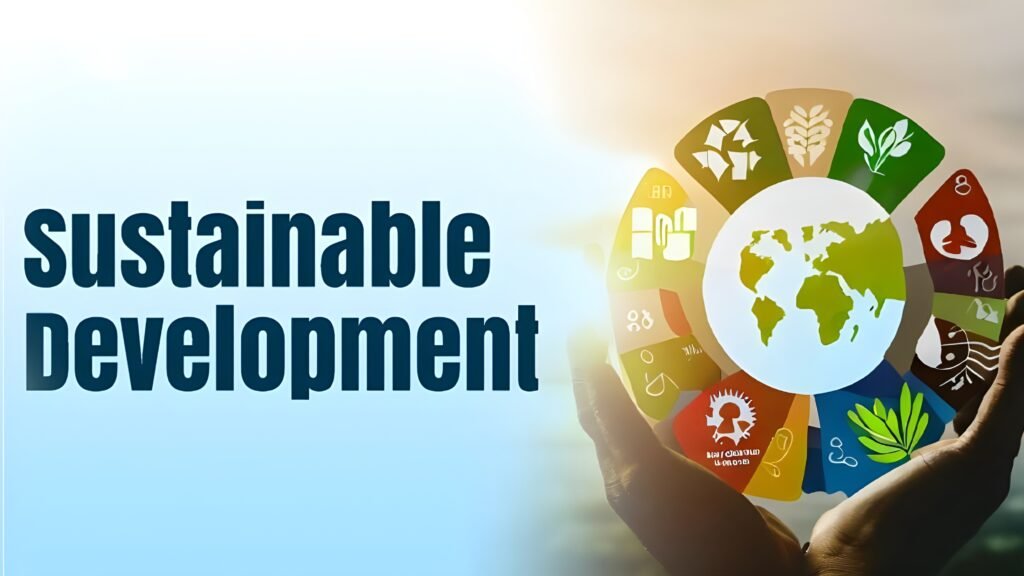
The 17 Sustainable Development Goals (SDGs) set by the United Nations are the world’s action plan to eliminate poverty, promote equality, protect our planet, and ensure quality education for all. Schools play a key role here because students shall collectively shape the future of this world. Sustainable Development Goal (SDG) 4: Quality Education is not just about going to school; it is also about learning the right skills to live responsibly and contribute meaningfully. This presents an urgent need to integrate curricula globally with the Sustainable Development Goal (SDG) values to ensure a holistic and equitable learning experience.
This is where Artificial Intelligence (AI) comes in as a powerful enabler.
What Is Artificial Intelligence (AI)-Powered Curriculum Mapping?
In simple terms, Artificial Intelligence (AI) can:
- Scan syllabi, textbooks, and activities
- Identify which Sustainable Development Goals (SDGs) are already being addressed
- Highlight gaps or missing themes (e.g., climate action, gender equality)
- Suggest relevant learning activities, content, and real-world applications
- Personalize content for different student needs
For Example, a class is learning about food chain here, Artificial Intelligence (AI) can recommend adding modules on sustainable agriculture (linked to Sustainable Development Goal (SDG) 2, “Zero Hunger”) or the impact of deforestation on biodiversity (linked to Sustainable Development Goal (SDG) 15, “Life on Land”). It helps schools move beyond rote learning to enable students to connect knowledge with action. Think of it like a smart GPS that helps schools align their learning journey with global goals.
Reimagining The Classroom
- As we integrate Artificial Intelligence (AI) into our schools, imagine a curriculum that is:
- Dynamic-updated regularly using global datasets
- Inclusive-designed to meet the needs of every learner
- Purpose-driven – every subject is linked to a global mission
- Localised – using local case studies, examples, and languages
- Picture a classroom where students don’t just learn math, but use math to solve real community problems like clean drinking water or waste segregation. That is the future we are building with students at the center.
Indian Innovations and NEP 2020 Alignment
- India’s NEP 2020 encourages schools to move away from rote memorisation to competency-based, multidisciplinary, and experiential learning. It promotes 21st-century skills l ike critical thinking, collaboration, and digital literacy. Artificial Intelligence (AI)-based curriculum design supports all of these.
- Central Board of Secondary Education (CBSE), in collaboration with tech leaders like International Business Machines (IBM) and Intel, has introduced Artificial Intelligence (AI) modules in several schools, focusing on using artificial intelligence to solve local community problems.
- The school education departments of Karnataka, Tamil Nadu, and Telangana have actively participated in implementing Artificial Intelligence (AI)-powered learning tools, which have benefited over 7 lakh students in more than 5,000 government schools.
- Delhi’s government schools are piloting Artificial Intelligence (AI) dashboards to identify students’ learning gaps early and customize teaching strategies to move toward personalized learning for all. Delhi has also embarked on training teachers for using Artificial Intelligence (AI) for non-teaching tasks, e.g., tackling extracurricular activities, making presentations, etc.
Global Best Practices And Examples
Let us also look at how leading institutions around the world are transforming education through Artificial Intelligence (AI) and Sustainable Development Goal (SDG) alignment:
Finland – Known for its educational excellence, Finnish schools use Artificial Intelligence (AI) to co-design cross-disciplinary modules. For example, a Grade 7 project on local food production integrated science (photosynthesis), economics ( costing), and Sustainable Development Goal (SDG) 12 – (Responsible consumption and production).
Singapore’s National Institute of Education (NIE) uses Artificial Intelligence (AI) to recommend teacher development courses based on classroom performance data. Their Edu Lab projects create learning journeys aligned with Sustainable Development Goal (SDG) 4 and digital fluency.
How Can Indian Schools Lead the Way?
With India’s digital infrastructure growing fast, initiatives like DIKSHA, NDEAR, and PM eVidyaschools are much better placed to become agents of change.
Here’s what we can do:
1. Design lessons that link textbook knowledge to global challenges: A lesson on fractions could involve calculating water usage (linked to Sustainable Development Goal (SDG) 6, “Clean water and sanitation”).
2. Create interdisciplinary projects: For example, a biodiversity survey (linking environment with botany, zoology, etc.) with GIS mapping (geography and technology) can link to Sustainable Development Goal (SDG) 15 – (Life on land).
3. Use Artificial Intelligence (AI) tools to track progress: Schools can use platforms that visualize curriculum-to-Sustainable Develop- ment Goal (SDG) mapping and suggest personalized learning plans. This can be particularly useful for students not performing up to the minimum standard and those with special needs.
4. Include student voice: Use Artificial Intelligence (AI) surveys and reflections to adapt content based on what students care about be it plastic pollution, gender justice, or mental health.
Final Thoughts: Empowering Future Change- makers
Artificial Intelligence (AI) is not here to replace teachers or textbooks it is here to empower them. It is a tool that helps schools become more inclusive, future-ready, and globally responsible. When used wisely, Artificial
Intelligence (AI) can ensure that every lesson taught in the classroom also teaches a lesson about the world we want to build.
It must be emphasized that students are not just preparing for exams they are preparing to solve real-world problems. Every subject they learn can be a seed that grows into climate action, innovation, equality and peace. As young learners, children and youth are not just students they are future leaders, scientists, artists, and changemakers. Their classroom is a training ground for a better India and a better world. With Artificial Intelligence (AI) as their ally and the Sustainable Development Goals (SDGs) as their compass, there is no limit to what they can achieve.
Let us not only learn from textbooks, but also learn from the world around us. Let us not only prepare for academic excellence, but also prepare for life. And let us ensure that every lesson we learn today brings us one step closer to a more sustainable, equal, and empowered tomorrow. Let us ensure that the curriculum of the future teaches not only what to think, but also why to think, and how to act.
References
- Vinuesa, R., Azizpour, H., Leite, I., Balaam, M., Dignum, V., Domisch, S., … & Nerini, F. F. (2020). The role of artificial intelligence in achieving the Sustainable Development Goals. Nature Communications, 11(1), 1–10. https://doi.org/10.1038/s41467-019-14108-y
- Castro, P., Almeida, F., & Costa, R. (2024). Artificial Intelligence (AI) literacy in the context of sustainable development in higher education: A systematic review. Frontiers in Education, 9, Article 1343406. https://doi.org/10.3389/feduc.2024.1343406
- The Times of India. (2025, June). Odisha govt to introduce Artificial Intelligence (AI) curriculum in most schools by 2036. https://timesofindia.indiatimes.com/city/bhubaneswar/govt-plans-to- introduce-ai-curriculum-in-most-schools-by-2036/articleshow/121658412.cms
- Holstein, K., Wortman Vaughan, J., Daumé III, H., Dudik, M., & Wallach, H. (2020). Co-designing Artificial Intelligence (AI) literacy curricula: Exploring teacher and student needs. arXiv preprint arXiv:2009.11100. https://arxiv.org/abs/2009.11100
About the author
Ashutosh Singh
Indian Forest Service (IFS)- Civil Service, Forest and Wildlife Management Divisional Forest Officer (DFO), Pithoragarh Forest Division
Uttarakhand